Showing posts with label public art. Show all posts

Monday, January 28, 2013

Tsunamis


Photo from http://tahniaroberts.blogspot.com/2012/03/phuket-kamalas-tsunami-memorial.html
How do you remember a tsunami?
Do you memorialize the victims?
Do you commemorate the towering and enraged seas that obliterated everything before them?
Do you attempt to make the memorials that will last forever, knowing that in fact nothing survives nature's fury?
Do you put them at the site of the devastation- or somewhere safer, somewhere less soaked in tragic memories?   

The range of answers to these questions fascinate me.
The Indian Ocean tsunami claimed 283,000 lives in 2004. Unimaginable in scale, it touched people worldwide. Two years later, in 2006, the Office of Contemporary Art and Culture in Bangkok and the Phuket called artists worldwide to create a memorial for three locations, including Kamala, one of the hardest hit places in Thailand.

 Thai sculptor Udon Jinaksa work, Heart of the Universe got the nod as the centerpiece of Kamala's memorial. It’s 30 feet high. The woven wire creates a huge circular form like a mighty crashing wave, so recalls the power of the sea in recalling its victims.
Louise Bourgeois (who was 96 at the time) interpreted things quite differently.  Her Hold Me Close in Hat Nopparat National Park features three bronze hands raised out of waves, grasping for one another.  She meant for it to be placed among trees near a pond.
In 2010, though, it was deteriorating due to its proximity to the sea, and the Thai government  removed it for repairs. At that time, they tried to contact her about appearing in another event called "Imagining Peace", and learned that she had died. Thus, all of her work became much more valuable. They debated about returning it to its original spot since it might easily be stolen there. The people of the area insisted that it be returned to its original stance, though. They felt removing it, even temporarily, dishonored her and the victims it was meant to remember. Eventually, the government did return it, unrepaired, to its original home.
1.4 km (about a mile) off the coast of Phi Phi Island, another area that was hit so hard in 2004, stands the only underwater memorial to the 2004 tsunami. 60 feet under water, it can only be seen by divers, though its locations is marked by bright yellow bouys. It consists of 3 granite markers about 150cm high. There is a smaller marker dead center. They represent the elements of eath, wind and water- the elements of any tsunami.

Officials in Thailand, hope that the memorial will lure divers and snorkelers back to the Phi Phi Islands. "The three pyramids represent the three elements of earth, wind and water. Man must keep all three of these elements in natural balance; otherwise the forces of nature will restore the balance themselves. We hope the monument will serve as a reminder of the need to maintain ecological balance," a spokeswoman said.

High reliefs have their place in remembering the victims. Yunan Province in China hosts a bronze medallion with lvie faces on once side, and, on the obverse, the same faces, but obviously floating and dead. It's immensly moving piece from Laury Dizengremel.

Some monuments are ephemeral, but while they exist, they are powerful- maybe because they recognize nature’s power to reclaim them.
Help Me, Help Me  was one of them. It was a sand scultpure of an incredibly realistic hand clawing out of the waves with the words ”Help Me” written at the end of the finger tips. For those who came on this giant work, it was startling and movieng. Of course it was swept into the sea as were the victims it commemorated.

In Japan, the 2011 tsunami that wreaked such devastation had another type of emphemeral reminder. Ice scultpures, some of birds rising from the earth and another of figures in the mist, haunted those who saw them, remembering the tragic loss of life behind them.

Photo from
 http://www.aroundthisworld.com/2013/01/08/bittersweet-visit-to-tsunami-ravaged-khao-lak-thailand/
And then there are the most pwoerful monuments of all- the informal messages tacked by survivors to rmember their loved ones.

Tsunami sculptures can also do more than memorialize past events.
James Kelsey, a Washington State sculptor, was moved by the 2004 tsunami, but was inspired by the tsunami evacuations signs in the area to create his own version. His website says, ”My own mother now lives on the coast of the Pacific Ocean. Every time I visit, I can't help but notice the warning signs every other block. The motion created in this piece is as if a wave crashing down upon the shore was frozen in time. I sometimes dread the raw power of our earth, but this piece isn't born of that fear, instead, it comes from the awe and wonder of the power in nature.”
 

Tuesday, January 22, 2013

Yarn bombing!

Yarn bombing!
When you least expect it, public art near you could be yarn bombed. Be aware. Be alert.
The big bronze catamount at West Carolina University in Cullowee, NC. sported a fetching 5 foot long red sweater complete with battery powered electric lights for a week in December. Jessica Breen from the WNC Fiber Folk Arts group knitted it for the mascot in four days on a knitting machine.  She told the University News there, “The Catamount got all my holiday knitting.”
The Twin Cities Knitting community in Minneapolis created sets of hats, scarves, and sweaters for the statues of Minnesota Twins players Rod Carew, Kent Hrbek, and Tony Oliva. The well-dressed sports heroes got their duds just in time for the worst cold snap in years.
(Photo from http://alabamakatel.blogspot.com/2011/08/yarn-bombing-in-pittsburgh.html?showComment=1358871019337#c3153449308341025595)

In Pittsburgh, PA the iconic Mr. Rogers sits along the river welcoming more generations of children to the neighborhood. But it's chilly in the city, and one kind soul, Alicia Kachmer, who is known as a yarn artist, decided to do something about her hero. She knitted him (what else?) a bright red sweater. Complete with zipper. It makes him look like the avuncular TV guy we all once knew and loved. One visitor to the newly-clad statue said, "He looks a lot less creepy" with it on.
In Santa Rosa, CA, the Stone Grandfathers, two massive statues, gifts from Bukujeju, South Korea (the city's sister city) looked chilly this month. So Judy Kennedy grabbed her needles and 10 skeins of yard to make both of them hats with ear flaps big enough to cover their 18" long ears in two weeks. She said she was inspired by the yarn bomber in NYC, who covered Wall Street’s Charging Bull Statue in 2011.
In Philadelphia, the statue of Rocky with his raised arms on the steps of the Philadelphia Art Museum got a new addition in May, 2011. He sported a fetching pink sweater emblazoned with the words, "Go see the Art" on it.
Last August, the statue of Albert Einstein at the National Academy of Arts and Sciences ended up swathed in a multicolored full body outfit of yarn art.
In Germany, less tastefully, a statue of a Sabine woman, sported a well-crafted wrist warmer.
"Yarn Bombing"  (also known as Yarnstorming or knit graffiti) is, officially, an international movement of fiber fans who knit, crochet, and otherwise create works fiber works to enliven the surroundings in grey cities. They’ve covered phone booths, light poles, door knobs, and, of course, statues with unexpected color and texture. The phenom began in the Netherlands according to some sources in 2004.
There’s even an International Yarn Bombing Day in June of each year.
Who and why they're made varies, but as opposed to graffiti and street art, they rarely have political or social agendas and they're easily removed. Though some towns restrict it, it's rarely banned, since the work is easily removed, and, for some reason, most folks like it.
There are those who object, though. they point out that all the time and effort to make an oversized sweater for a statue which really can't feel the cold could more easily be put into making warm garments for the homeless and others who could really use it. But for now, I'll take clothing statues as a clear indication of how we related to public art. And that's a good thing.
http://yarnbombing.com/

Thursday, January 17, 2013

Top Down- or Bottoms up???


So public art is almost guaranteed to be a can of worms- reaction-wise.
Not only do people squabble about aesthetics, but if their tax dollars pay for a piece, someone is always bound to ask, “How the hell did THAT get there?”
I hunted down the answers to that very question on the web the other day, and ran across three stories that opened up another question- mainly, “Does the process of placing public art affect the way people react to it?”
Their juxtaposition knocked me out.
The first described the public’s response to two proposed pieces for Dunnet Beach in Caithness, Scotland. They had gone through a typical “top down” approval process by the Highland Council’s Landscape Office, which had determined that they’d enhance an important  place in the area.
But the sculptures were nixed by the public during a meeting of the local council. Citizens highly objected to the works themselves, their placement, and to the fact that they had had no say in their selection. So it was back to the drawing board for the officials, who had hoped to have the pieces in place for the summer season.
One former local councilman feared that failure to agree on the design could cause the area to lose the £50,000 allotted to the project.
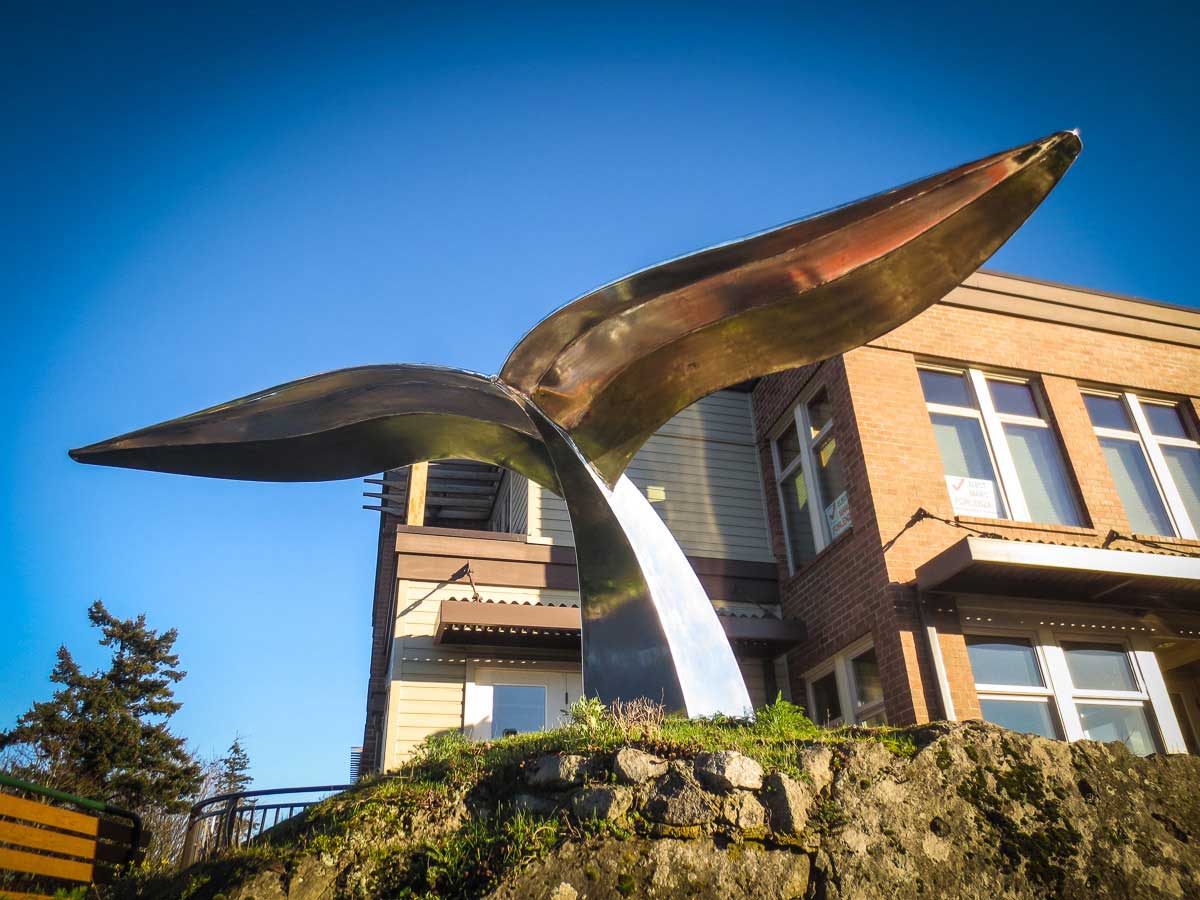
The second story discussed a “bottoms up” process to erect the first piece of public art on Friday Island in Puget Sound. The polished aluminum whale’s tail called “The Fluke” had been displayed at a local resort for a year when the local sculptor put it up for sale. He offered it to the town at a discounted price because he wanted it to stay on the island. 27 residents donated cash to snag it for a public spot near the ferries.
Locals not only liked the piece, they hoped it would be the first of many public art works on the island.
The final report, probably the most fascinating,  came from Weymouth, England. Private businesses chose to fund a statue for the town, but instead of selecting an existing sculpture or design, they hired an artist, Andy Kirkby, to create one that would fit the location..
The Dorset Echo, a local newspaper, reported that, “Andy said he is looking forward to meeting local people at a public meeting in January, where he hopes to gather important local key themes and aspirations for the design from the community. Schoolchildren will be involved in model-making and it is hoped a link can be established with Weymouth College students.
A blog will also be set up so people can put forward their suggestions and feedback.”
In other words, it will be art with full consent of the governed. It remains to see how that works out for them.
So according to these three stories, bottoms up decisions are more likely to get the nod, and top down the raspberry, for public  reaction.
On a related note, I found a fascinating blog post about the process that's most commonly used for choosing work under the Percentage for Art around the nation.
Popular since Phildelphia started it in 1959,  it allocates a percentage of the cost of public construction (usually from .5-1% of the total cost) for public art for the community's enjoyment. It's a fairly straightforward process. You can find the whole thing here:
http://youcallthatart.net/2010/10/22/blog-who-picks-it/

Tuesday, June 26, 2012

Sacrifice and decay

Who is Jerry Rubin, and why is he chained to a fence?
Why is he fasting for 10 weeks?
And what does all of this have to do with public sculpture?
I'm here to enlighten you, my friends, with a story straight out of our flower-powered past.
Seems that there's  an anti-nuke sculpture, designed by a political cartoonist in the early 90's standing near the Civic Center in Santa Monica.
(picture from the Santa Monica Patch)

Shaped like a mushroom cloud, it's made of chain links and is called, appropriately enough, "Chain Reaction" to protest the arms race when it was built. As a matter of fact, its inscription reads- "This is a statement of peace. May it never become an epitaph". A worthy hope indeed.
But time and wear have endangered the hope. According to the Lookout News, "The 22-year-old sculpture was deemed unsafe after structural engineers retained by the City found that many of the fasteners that attach the copper tubing chain to the fiberglass core were either missing, not fully embedded or exhibited severe corrosion. City Staff estimates that preserving the statue could cost anywhere from $227,372 to $423,172, and that there is no guarantee how long the repairs would last."
Enter Jerry Rubin (no- not that Jerry Rubin!), a peace activist, who feels that the council's refusal to fund repairs and threats to decommission the piece are a political tragedy. In order to rally the troops (and the cash needed) to fight the decisions, he has chained himself to the surrounding fence and will live on liquids only for 10 weeks.
I am thrilled that anyone cares that much about public art these days. The world, in fact, not all as bloodless as it seems any more.
Read all about it at:
http://santamonica.patch.com/articles/peace-activist-will-fast-to-save-anti-nuke-sculpture#photo-9023144

Sunday, June 24, 2012

It's a rock, dad...

Remember the story of the King's new clothes? The kid who saw the royal altogether and named it for what it was nailed the absurdity of the situation.
Today I feel just like the clear-eyed kid...
Crowds from all over the LA area raced to see the new scultpure- "Levitated Mass"- installed at the LACMA after its 11 day journey from its home quarry to downtown Los Angeles. Along the way crowds cheered its progress and even held street parties to celebrate the massive boulder.
For that's what this 10 million dollar giant is.
A Rock.
A Boulder.
Perched on  a sluice way by solid (we all hope) struts so that people can- WALK UNDER IT!!!
http://www.latimes.com/entertainment/arts/culture/la-et-cm-lacmas-rock-opens-and-the-masses-descend-20120624,0,3184913.story
Michael Govan, LACMA's chief, gushed- As Michael [Heizer] said to me once, 'When do you get to see the bottoms of sculptures?"
Spare me.
Ever been in a cave, Mike? There are tons of nature's sculptures in them called stalactites that will hang over your head for free- and in the most amazing combinations!
And all over the world, from Zimbabwe to MA, you can see balanced rocks that have been there for centuries for free!
Yet Angelenos gawk and snap their cameras, documenting a change in their line of sight. It never occrued to many of these art-goers that they can change perception by moving their point of view. God bless us every one.
It's only a rock, dad....

Tuesday, May 01, 2012

Disneyland next????

Ever wonder what would happen to Disneyland in a post-apocalyptic world? Just think what it would look like if the kudzu and alligators had their way in FL and the strange figures were discovered by another race.
Now look to East Berlin. Before the fall of the wall. Before the cold war thawed. Before the the 1% finally took over the comrades.
1969. The GDR erected Kulturpark Plänterwald in that city for the soviet amusement of the proletariat.
1989. Newly minted "private interests" in the form of a family took over the failing spot and renamed it Spreepark (not what you think- it's after the river). Dinosaurs were added. A ferris wheel dominated the landscape.

2001. The park tanked and sat abandoned while nature, as they say, took its course.
Then- resurrection! The invasion of the artists!
http://kulturpark.org/Kulturpark-Presentation-2012.pdf
Next month, they will stage a "poetic intervention" to transform the haunting space into a public art extravaganza.
Now, I have a secret passion for industrial ruins, and this is a subset- the entertainment ruin- so the story is a dream come true... I've even signed on to their Kickstarter campaign. you can, too!http://www.kickstarter.com/projects/1353197694/kulturpark

Thursday, April 05, 2012

Kickstartin' it!

Now, I am a great fan of kickstarter.com- that financier of films (it funds more films than the NEA), art, invention and social causes. And today, this hero site and public sculpture have collided in a particularly encouraging way.
(Photo frm Kickstarter.com campaign)

The New York Daily news tells the story of Pedro Villalta and Montserrat Daubon, two NYC sculptors who felt that the midtown crowd was gettng quite enough public sculpture, thank you, on their boulevards and avenues, and Harlem was getting left in the dust.
So they took their plans for a 10ft. high stainless steel "Giant Pod" to the Department of Transportation, got the nod to install it on Malcolm X Blvd. at 124th St. for 11 months, and hit kickstarter to get the majority of the dough to make it happen. As of today, it's a go.
 http://www.nydailynews.com/new-york/uptown/artists-successfully-raise-money-sculpture-median-harlem-malcolm-x-blvd-giant-pod-sprout-june-article-1.1055912?localLinksEnabled=false
So this raises the question of funding the arts and how its changed in the past few years. Foundations and government programs have been tightening their grip- especially on independent, low-visibility artists. Corporations pretty much cast their nets with an eye to great publicity and investment schemes. Local groups (like the  Mount Morris Park Community Improvement Association, which doanted $1,000 to this cause) just don't ahve that much dough to spread around.
But vacuums don't hold forever, and alternative funding (begging) through the internet has jumped into the pool and is splashing the hell out of traditional sources.
But because of the labor-intensive nature of this funding (those seeking support must do all of their publicity, etc. on their own) it can hit or miss. But it doesn't take any longer than writing a grant and grant reports would have done before.
I myself have had one successful campaign to get archival footage for a doc, and am nearly at the end of a nail-biting campaign to fund my latest film at indiegogo.com/Free-Elephants... My hats off to these innovative sculptors and their concern for public art...

Thursday, March 08, 2012

When art and signage collide...

 (Photo from Eavacuteer.org)
So I was pretty hesitant to check out the latest New Orleans public art project when I heard that it was made of stick figures. How good could they be?
But I've got to admit that Douglas Kornfeld's 17 sculptures of universal symbol-type figures hailing a passing vehicle are pretty engaging. Easy to understand and big enough to see.
They're going to be placed at designated spots around town to help people get transportation out of danger should another hurricane slam into that beleagured city.
This brings up the whole question of double duty art.
Although a lot of public sculpture is informally used as meeting spots for people, giving directions, etc., pieces specifically designed for signage give rise to the question- "Is it good art, or good signage?"
Can this work be both at once?
I'm looking for more examples and welcome remarks and links...
 http://www.boston.com/news/local/massachusetts/articles/2012/03/07/sculptor_chosen_for_orleans_evacuation_art/

Wednesday, March 07, 2012

Proposing art

(Image from Timessquarenyc..org)

There's so much news in the world of public sculpture this AM that I'm dizzy with it all.
New York City is going gangbusters with huge street art on Park Avenue (see earlier post) and the new Times Square Alliance-backed installations.
The first, called the Manhattan Oil Project, recreates two 25' high oil pumps in shiny black and fetching red that are supposed to evoke a pletora of responses from the viewer, who, of course, will "get" the art proposalese explanation by the artist in an instant. Being a new criticism kind of gal, I find this piece particularly difficult to swallow.
Right near the industrial/economic irony that is the MOP stands a quieter piece made of white marble, which does lead the viewer to a certain calmness and peace in the midst of the chaos of that overwrought crossroads.
But to read the proposal statement, you'd never guess it.
So I guess today's theme is all about- what can you really know about a piece of public art/sculpture from reading its proposal???
http://artdaily.org/index.asp?int_sec=2&int_new=54064