Thursday, January 17, 2013

Top Down- or Bottoms up???


So public art is almost guaranteed to be a can of worms- reaction-wise.
Not only do people squabble about aesthetics, but if their tax dollars pay for a piece, someone is always bound to ask, “How the hell did THAT get there?”
I hunted down the answers to that very question on the web the other day, and ran across three stories that opened up another question- mainly, “Does the process of placing public art affect the way people react to it?”
Their juxtaposition knocked me out.
The first described the public’s response to two proposed pieces for Dunnet Beach in Caithness, Scotland. They had gone through a typical “top down” approval process by the Highland Council’s Landscape Office, which had determined that they’d enhance an important  place in the area.
But the sculptures were nixed by the public during a meeting of the local council. Citizens highly objected to the works themselves, their placement, and to the fact that they had had no say in their selection. So it was back to the drawing board for the officials, who had hoped to have the pieces in place for the summer season.
One former local councilman feared that failure to agree on the design could cause the area to lose the £50,000 allotted to the project.
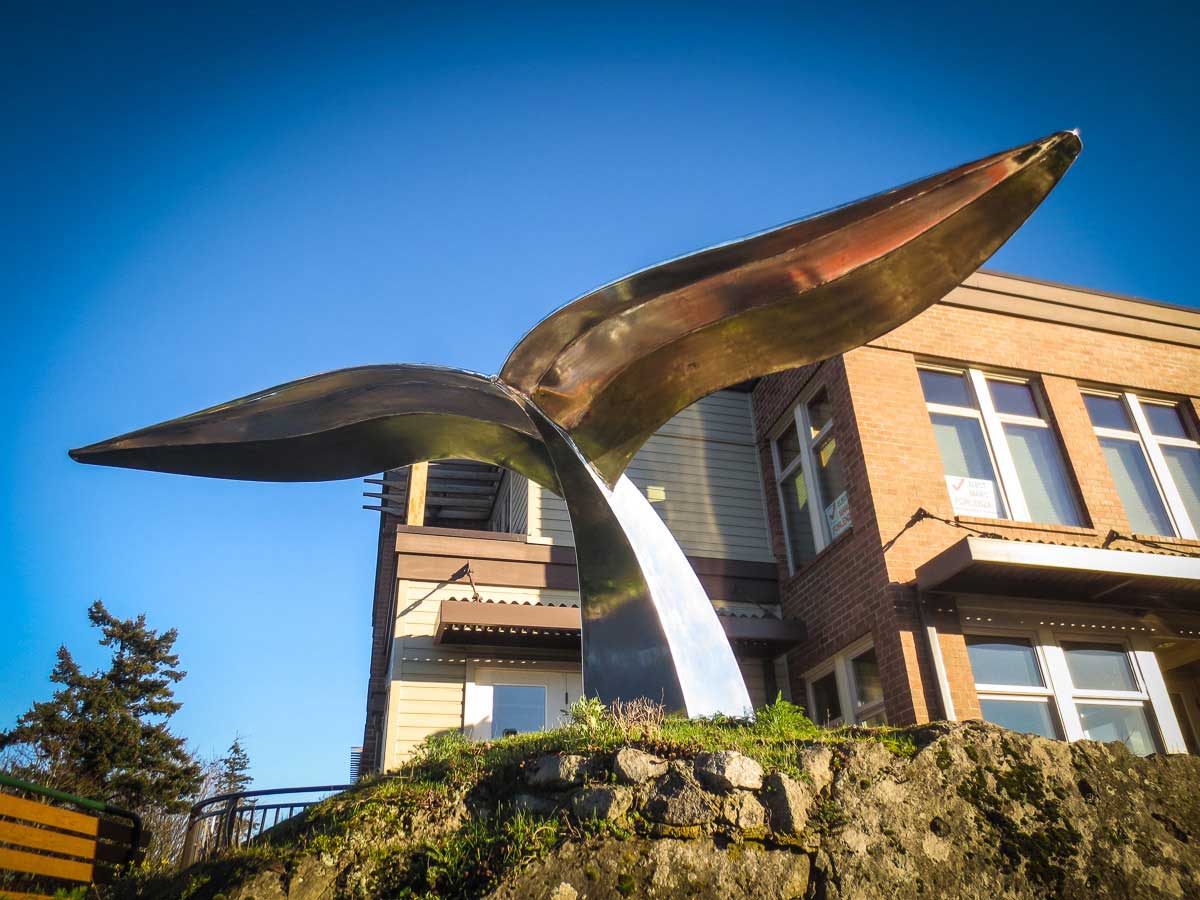
The second story discussed a “bottoms up” process to erect the first piece of public art on Friday Island in Puget Sound. The polished aluminum whale’s tail called “The Fluke” had been displayed at a local resort for a year when the local sculptor put it up for sale. He offered it to the town at a discounted price because he wanted it to stay on the island. 27 residents donated cash to snag it for a public spot near the ferries.
Locals not only liked the piece, they hoped it would be the first of many public art works on the island.
The final report, probably the most fascinating,  came from Weymouth, England. Private businesses chose to fund a statue for the town, but instead of selecting an existing sculpture or design, they hired an artist, Andy Kirkby, to create one that would fit the location..
The Dorset Echo, a local newspaper, reported that, “Andy said he is looking forward to meeting local people at a public meeting in January, where he hopes to gather important local key themes and aspirations for the design from the community. Schoolchildren will be involved in model-making and it is hoped a link can be established with Weymouth College students.
A blog will also be set up so people can put forward their suggestions and feedback.”
In other words, it will be art with full consent of the governed. It remains to see how that works out for them.
So according to these three stories, bottoms up decisions are more likely to get the nod, and top down the raspberry, for public  reaction.
On a related note, I found a fascinating blog post about the process that's most commonly used for choosing work under the Percentage for Art around the nation.
Popular since Phildelphia started it in 1959,  it allocates a percentage of the cost of public construction (usually from .5-1% of the total cost) for public art for the community's enjoyment. It's a fairly straightforward process. You can find the whole thing here:
http://youcallthatart.net/2010/10/22/blog-who-picks-it/

Wednesday, January 16, 2013

The Top Ten


5 million people can’t be wrong- can they?
China’s life and culture website, sohu.com, opened the lines for everyone to vote on the “Top Ten Ugliest Sculptures in China of 2012” last August with 59 candidates vying for the honor. Nearly 4 months later, the votes were in- 4,983,916 of them, to be exact, and the “winners” were posted for all to see.
 
I’ve seen the finalists in this contest at http://arts.cul.sohu.com/s2012/chouloudiaosu/ and was fascinated. Some clearly deserved the honor, like the 20’ long mouse with stainless steel figures running along its wire at an “Electronics Computer City” and “Smoke Children” which appears to be a series of connected brightly colored blobs (the colors change every year). But some, like the graceful “Canal Mother” and a classical "The North Sea" piece mystify me.
What makes a public sculpture “ugly”? How did these pieces get there in the first place? What did their owners and artists think of the designation? Were/will any of them be removed?
Pointing disapproving fingers at unfortunate sculptures isn’t new. Just a quick googling will yield  “12 of the World's Ugliest Statues”,  “Ugliest Statues in Seattle,” etc.  As a matter of fact, a July 5, 1882 headline in the NY Times declared, “Ugly Statues in London- some of the Best and Worst of a Generally Bad Lot”.
But back to China and its disgraced sculptures.
Obviously, some of the sculptors weren't happy with their work’s designation, nor were the local councils who erected them in the first place.  But, obviously, those who had to live with them day by day weren't about to be blocked from having their say.
Bad art in a town makes the whole town look bad, according to some commentators.
What makes a sculpture ugly? I found it difficult to find a connecting thread, but some of the most common elements were abstraction, bright colors, and unusual materials. Some of the pieces were a bit too graphic for the public, like that of an old man being carried, balls out, by two women. It was called "Supporting the Old".  (All translations by google translator, so they may not be the most elegant phrasing possible.)
In a few cases, though, inappropriate placement was what got the work the nod.
 Will the pieces be removed? "Smoke Children" the colorful blob set in front of a hotel, has already been dismantled, though it's not clear whether that was a result of its inclusion in the contest or not. It had been raised during the 2010 Olympics, and may just have reached its "sell by" date. 
But the contest was successful in a broader way, according to the chief director of Sohu.com, which sponsored it.
"With the help of such events, we hope to present the current situation to the public and increase discussion on topics like city construction."   And the Committee's secretary-general Duan Xichen, added, "The event also made the public begin to pay attention to city sculptures and eventually make them beautiful."
Not mentioned is the fact that this event could be a real stimulus to future arts commissions to think closely about what works they place in public!
That's a worthy enough goal for any event, as far as I'm concerned, though I'd love to see an international contest for "The Top Ten Most Beautiful/ Powerful/ Thought-provoking" statues in the world.

Saturday, December 29, 2012

This just in

I'm fascinated by the concept behind a sculpture that was installed in the Warsaw Ghetto in Poland last month.
The reactions to the placement and content have been predictably controversial.
When I found out about "Him", the statue of Hitler at prayer, I wanted to know what was behind it.
Who conceived it?
Wat was he trying to say?
How did it end up in the Warsaw Ghetto?
 
I found that the artist Maurizio Cattelan, an Italian artist based in NYC is known as a satirist, and, as his entry in wikipedia points out, "his work seeks to highlight the incongruous nature of the world and our interventions within it no matter where they may lie."
This piece certainly does that.
Does a physical posture make a man good- or evil?
Are we certain Hitler didn't pray?
Is this a symbol of hypocrisy or repentance?
I found out that Poland's foremost rabbi who was consulted on the placement agreed that this was a worthy project because it made people question what they knew about the face of evil
But this isn't the only place the statue has been shown. It's been on display all over the world, including the Guggenheim in NYC.
"When people see this piece, they react with gasps, tears, disbelief. The impact is stunning," collector and Holocaust survivor Stefan Edlis told The Economist in 2009. "Politics aside, that is how you judge art.” 
For more info, check out:
http://artdaily.com/index.asp?int_sec=2&int_new=59818
http://www.towleroad.com/2012/12/should-maurizio-cattelans-hitler-pray-in-warsaw-ghetto.html#ixzz2GSVBLzu4

Friday, September 21, 2012

A most amazing blog post!

I've gotten behind in my own posts, but couldn't resist passing this cogent piece on from a fave sculpture writer of mine- Kirk Savage-

http://www.kirksavage.pitt.edu/?p=454

Monday, August 20, 2012

Taking it Out on Bronze


Of course I have to talk about the Joe Paterno statue debacle.
Joe was a hero and Joe was a scoundrel who sacrificed young children for the sake of saving face. He had, as so many heroes do, clay feet (to put it sculpturally). I don’t know enough about the actual events to make a solid judgment of his action or lack of it, but what I’ve read seems pretty damning.

This post is not about Joe Paterno the man, but Joe Paterno the statue. The seven foot tall bronze action figure who used to hail people in front of Penn State’s football stadium was removed in July and put into storage.

According to Penn State President Rodney Erickson, "I now believe that, contrary to its original intention, Coach Paterno's statue has become a source of division and an obstacle to healing in our university and beyond. For that reason, I have decided that it is in the best interest of our university and public safety to remove the statue and store it in a secure location. I believe that, were it to remain, the statue will be a recurring wound to the multitude of individuals across the nation and beyond who have been the victims of child abuse."

http://articles.chicagotribune.com/2012-07-22/sports/chi-paterno-statue-20120722_1_freeh-report-joe-paterno-coach-paterno

This isn’t the first time that a public figure who is “in disgrace with fortune and men’s eyes” has hit the ground. Take the famous Brazilian footballer Ronaldhino, whose 23 foot likeness was toppled after Brazil lost in the 2006 World Cup. And in 2009, all of Venezuela’s statues of Columbus came down as Hugo Chavez fingered him for the genocide of the Native American people. Of course, there were the Stalin, and Lenin, images that came down in the 20th century, to say nothing of the Saddam Hussein statues that American troops pulled down for the Iraqis in 2003.

It’s better than killing the guys in person and it’s a great catharsis.

Thursday, July 05, 2012

Breaking News

(Photo from muslimvillage.com)

Remember the Buddhas of Bamiyan? The 2000 year old figures of Buddha in northern Afghanistan were blown to smithereens by the Taliban (but there’s a whole back story there) in 2003. Shortly afterward, I researched the event and predicted that the events of cultural assassination would be increasing in the next several years.
Enter Timbuktu.
The priceless  Mausoleums in this “City of 333 Saints” were listed as an endangered World Cultural Heritage site by UNESCO. Last week, the fundamentalist Islamic group Ansar Dine group, who   grabbed the area withTuareg fighters in April, took exception to the designation. They began battering away at the priceless tombs with pickaxes and hammers claiming the rights to purify the area of idolatry. So far they’ve pulverized eight of the Muslim shrines.
According to UNESCO’s Director Irina Bokova, This destruction is deliberate, undertaken in cold blood to catch the world's attention and destroy the last defenses of Malian identity and strength.
http://www.cnn.com/2012/07/02/opinion/unesco-mali-opinion/index.html
The International Criminal Court has named this kind of cultural destruction a war crime.  

The whole event is sickeningly like Bamiyan and, unfortunately, unlikely to be the last. Which leads to the question, how important are monuments to us all?
And, more widely, how do we rate monuments worthy of protection and those that can be dispensed with for other reasons. This opens a whole can of worms that I'll explore some other time, but for now, get more details at   http://seattletimes.nwsource.com/html/travel/2018589317_webmali03.html

Thursday, June 28, 2012

I Like Ike-

(Photo from Newsday)
So there's a monumental controversy in DC about one of our least controversial presidents.
Surprised? Not much.
It's finally time, it seems, to honor Ike, that symbol of post war America. No one doubts that we could all benefit from remembering the grandfatherly prez- the question (as usual) is how. What do you memorialize? His accomplishments? His background? His really cool jacket?
Congress OK'd the idea of a memorial back in the last century- 1999, to be exact. By 2005 they gave the nod to the site across from the National Air and Space Museum.
By 2010, Frank Gehry's concept of a wall relief of Ike's Greatest Hits with a young Dwight D. looking on was unanimously approved by the Eisenhower Memorial Committee, including grandson David Eisenhower. Then the storm blew in.
To make a long story short, people (family included) objected to the emphasis on young Ike. Gehry changed it. Then the National Civic Art Society opened a new competition for a more congenial design. They established their web presence with a website at  http://www.eisenhowermemorial.net/  to tell their side of the story.
David E. bailed from the original committee.
Granddaughter Susan held press conferences.
The saga continues.
For those of us who remember the brouhaha that introduced Maya Lin to DC, this is more of the same- with cyberspace overtones.
But now, there's a new twist.
Enter, the US Congress. No clear consensus on what you're building, the House Appropriations Committee said, no more funds in 2013. That's getting to the core of the matter. And, for once in my life, I have to say I agree with these guys.
The best discussion of the controversy I've read so far comes from a Washington Post blog- http://www.washingtonpost.com/blogs/arts-post/post/david-brookss-criticism-of-eisenhower-memorial-design-falls-short/2012/06/13/gJQAtUurZV_blog.html

Tuesday, June 26, 2012

Sacrifice and decay

Who is Jerry Rubin, and why is he chained to a fence?
Why is he fasting for 10 weeks?
And what does all of this have to do with public sculpture?
I'm here to enlighten you, my friends, with a story straight out of our flower-powered past.
Seems that there's  an anti-nuke sculpture, designed by a political cartoonist in the early 90's standing near the Civic Center in Santa Monica.
(picture from the Santa Monica Patch)

Shaped like a mushroom cloud, it's made of chain links and is called, appropriately enough, "Chain Reaction" to protest the arms race when it was built. As a matter of fact, its inscription reads- "This is a statement of peace. May it never become an epitaph". A worthy hope indeed.
But time and wear have endangered the hope. According to the Lookout News, "The 22-year-old sculpture was deemed unsafe after structural engineers retained by the City found that many of the fasteners that attach the copper tubing chain to the fiberglass core were either missing, not fully embedded or exhibited severe corrosion. City Staff estimates that preserving the statue could cost anywhere from $227,372 to $423,172, and that there is no guarantee how long the repairs would last."
Enter Jerry Rubin (no- not that Jerry Rubin!), a peace activist, who feels that the council's refusal to fund repairs and threats to decommission the piece are a political tragedy. In order to rally the troops (and the cash needed) to fight the decisions, he has chained himself to the surrounding fence and will live on liquids only for 10 weeks.
I am thrilled that anyone cares that much about public art these days. The world, in fact, not all as bloodless as it seems any more.
Read all about it at:
http://santamonica.patch.com/articles/peace-activist-will-fast-to-save-anti-nuke-sculpture#photo-9023144

Sunday, June 24, 2012

It's a rock, dad...

Remember the story of the King's new clothes? The kid who saw the royal altogether and named it for what it was nailed the absurdity of the situation.
Today I feel just like the clear-eyed kid...
Crowds from all over the LA area raced to see the new scultpure- "Levitated Mass"- installed at the LACMA after its 11 day journey from its home quarry to downtown Los Angeles. Along the way crowds cheered its progress and even held street parties to celebrate the massive boulder.
For that's what this 10 million dollar giant is.
A Rock.
A Boulder.
Perched on  a sluice way by solid (we all hope) struts so that people can- WALK UNDER IT!!!
http://www.latimes.com/entertainment/arts/culture/la-et-cm-lacmas-rock-opens-and-the-masses-descend-20120624,0,3184913.story
Michael Govan, LACMA's chief, gushed- As Michael [Heizer] said to me once, 'When do you get to see the bottoms of sculptures?"
Spare me.
Ever been in a cave, Mike? There are tons of nature's sculptures in them called stalactites that will hang over your head for free- and in the most amazing combinations!
And all over the world, from Zimbabwe to MA, you can see balanced rocks that have been there for centuries for free!
Yet Angelenos gawk and snap their cameras, documenting a change in their line of sight. It never occrued to many of these art-goers that they can change perception by moving their point of view. God bless us every one.
It's only a rock, dad....

Tuesday, May 01, 2012

Disneyland next????

Ever wonder what would happen to Disneyland in a post-apocalyptic world? Just think what it would look like if the kudzu and alligators had their way in FL and the strange figures were discovered by another race.
Now look to East Berlin. Before the fall of the wall. Before the cold war thawed. Before the the 1% finally took over the comrades.
1969. The GDR erected Kulturpark Plänterwald in that city for the soviet amusement of the proletariat.
1989. Newly minted "private interests" in the form of a family took over the failing spot and renamed it Spreepark (not what you think- it's after the river). Dinosaurs were added. A ferris wheel dominated the landscape.

2001. The park tanked and sat abandoned while nature, as they say, took its course.
Then- resurrection! The invasion of the artists!
http://kulturpark.org/Kulturpark-Presentation-2012.pdf
Next month, they will stage a "poetic intervention" to transform the haunting space into a public art extravaganza.
Now, I have a secret passion for industrial ruins, and this is a subset- the entertainment ruin- so the story is a dream come true... I've even signed on to their Kickstarter campaign. you can, too!http://www.kickstarter.com/projects/1353197694/kulturpark

Monday, April 30, 2012

Location, location, location

(Photo from invisiblebordeaux.blogspot.com)


I often tell anyone who will listen that a huge part of the effectiveness of memorials, and, in fact, any type of public sculpture, is the siting. Sticking a bust of Beethoven outside of his birthplace has a lot more effect than it would in an Iowa cornfield (or- maybe not... that could become a destination in itself).
An excellent example of this comes from Bordeaux, France.
I found out about it in one today's post of one of my fave blogs- Invisible Bordeaux.
http://invisiblebordeaux.blogspot.fr/2012/04/toussaint-louverture-helping-bordeaux.html
Now the strength here is that the statue of the hero of slave trade abolition is not only set in a prominent spot, but it also overlooks the docks where the French slave ships started their journeys to Africa to pick up their human cargo. There is a giant plaque on that dock that marks its role in this misery.
You can immerse yourself in both the nadir and triumph of the era in one short hop.
If this were on a streetcorner in the suburbs, it might get a glance or two, but here- it works on a whole other level.
The piece itself is a pretty standard bronze bust on a stand, but looking at the other work by the Haitan artist, Ludovic Booz, which is sleek and clear, I assume the reason that he chose this form was for historical connection. Would a modern piece have as much power or effect? Perhaps not..

Monday, April 09, 2012

Extinguish the flame?


I wasn't aware (shockingly) of "The Sphere".
It began life as a bronze and steel monster in the center of a plaza at NYC's now demised World Trade Center. Meant to celebrate world peace through commerce, it was center stage for the events of 9/11.
Amazingly, it survived the attack intact. Symbolically and physically.
Since 2002, it's stood in Battery Park guarding an "eternal flame" that was lit by world leaders including Mayor Bloomberg and Karzai on the first anniversary of the tragic attack.
Now- (symbolically?) the gas line to the eternal flame is slated to be cut and the ball of peace will be moved- but no one knows where. Battery Park needs renovations and the 25 ft high ball just doesn't fit in the plan.
http://artdaily.org/index.asp?int_sec=2&int_new=54650